

It has taken me longer than I thought to work my way through a series of posts on Uncle Tom’s Cabin, but better late than never, as they say.
The final chapters of Harriet Beecher Stowe’s novel will not surprise readers familiar with Romantic literature, broadly speaking. Multiple plot lines get tied up neatly with the sudden appearance of a new character or two as well as the revealing of heretofore undisclosed connections between other characters. Uncle Tom himself dies a martyr’s death, transcending his horrific circumstances, and his example leads to widespread reform.
After the death of Augustine St. Clare, Ophelia tries to get his widow to honor his wish to free Tom. Predictably, she refuses, opting instead to sell Tom with several other hands as she plans to liquidate the plantation and return to her family’s home. Tom ends up being bought by Simon Legree, the biggest villain of the novel.
Tom is taken to Legree’s remote Louisiana plantation along with Emmeline, a teenaged slave who apparently is intended to be Legree’s concubine. At the plantation, Tom meets Cassy, another of Legree’s concubines. She is a “quadroon” who has refined bearing and manners and is literate, and the other slaves on the plantation defer to her, even the brutal overseers. She tells Tom that her former owner fathered two children by her and had promised to free and marry her, but that he had ultimately sold her and the children to clear his gambling debts, and that their new master then sold both her children, leaving her with no one. After more travails, she ended up with Legree. She thinks of taking her own life now that it appears she will be supplanted by Emmeline, but Tom persuades her to hang onto hope.
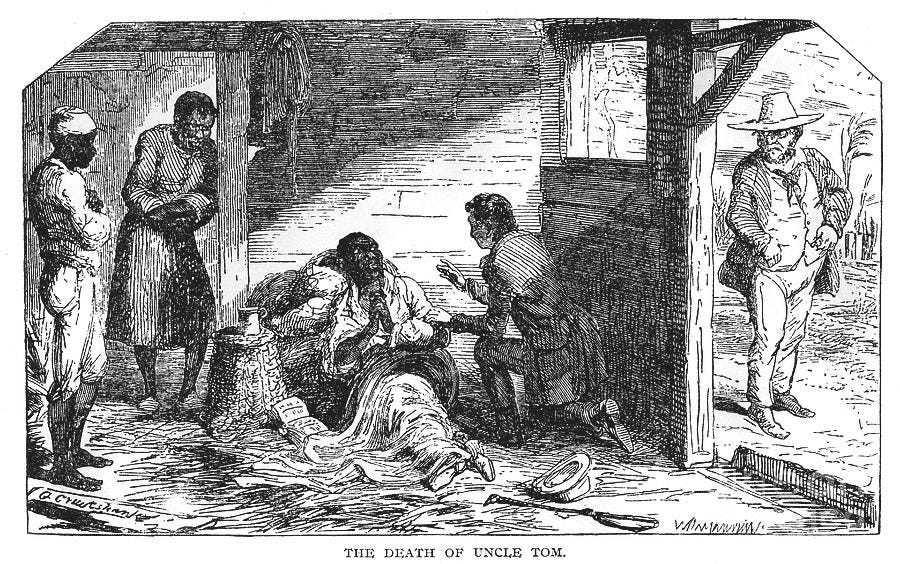
Legree plans for Tom to become an overseer, but he refuses, saying he will never raise a hand against any other slave. He meekly submits to the beatings he receives as a result. He later assists Emmeline and Cassy in their escape from the plantation. Legree then beats him so severely that he ends up on his deathbed.
In the meantime, “young master” George from Tom’s Kentucky plantation has been searching for Tom to buy him back. After tracking him from New Orleans, he finally arrives at Legree’s plantation to find Tom on his deathbed. Tom’s example has converted many of the slaves on the plantation to Christianity, even the overseers who had beaten him, and he bids farewell to George after expressing a hope for Legree’s repentance and conversion. Nevertheless, after the wicked plantation owner speaks disrespectfully of Tom, George, “with one indignant blow, knocked Legree flat upon his face; and, as he stood over him, blazing with wrath and defiance, he would have formed no bad personification of his great namesake triumphing over the dragon.”
George buries Tom and sets out on his return journey to Kentucky, and here is where the deus ex machina element comes in. Cassy and Emmeline, who have learned of George’s connection to Tom, seek his help; Cassy is posing as a wealthy Creole with Emmeline as her attendant. George helps her get a stateroom on the same riverboat he is traveling on. Also traveling on the boat is a wealthy French widow, Madame De Thoux. Mme. De Thoux is a former slave whose former master took her to the West Indies, freed, and married her, and that she had now returned to the USA following the death of her husband to seek after her brother.
It turns out that Mme. De Thoux’s brother is Eliza’s husband, George, who successfully escaped from the Harris plantation earlier in the novel and is now in Canada. Moreover, in the course of the conversation, Cassy realizes that Eliza fits the description of her own daughter who had been taken away from her years earlier.
Stowe buttons up the narrative quickly after this. Mme. De Thoux, Cassy, and Emmeline all go to Canada, where they are reunited with George and Eliza. They then decide to strike out for Liberia (!) and help build a free society. Young Master George, meanwhile, returns to the Kentucky plantation and frees all the slaves there. The influence of Uncle Tom’s righteous life thus extends across the continent and beyond.
In the final chapter, Stowe speaks in her own voice, explaining her own experiences and interviews that had given her some insight into the slave system, despite never having visited the South or seen the system operate up close.
This novel was a long slog. I have heard it criticized as containing a sort of over-the-top pathos, but it didn’t seem to be too far outside the mainstream of Romantic literature in that sense, as far as I could tell. I can easily see how it could have had a dramatic impact on the national debate over slavery in the 1850s. I also think that the people who deploy “Uncle Tom” as an insult today don’t understand the novel properly.
This is a great work of American literature. It takes some work to get through, but it’s worth the effort.